 JOGLP
Walk the length of Britain
John o' Groats
to Lizard Point
All the way through Great Britain: from the far north-east of Scotland to the southern tip of Cornwall. 1,766 km on 8 trails – with route, GPX, stage planner and as many nights outdoors as possible.
Our take on the classic LEJOG/JOGLE: instead of Land's End we finish at Lizard Point, the southern tip of Cornwall. Why Lizard Point? · Compared with the End to End Trail
- km
- 1,766
- trails
- 8
- days at 32 km
- ~56
- ascent
- 31,391m
From north to south
8 trails, one route: cliffs and the North Sea, lochs and Highlands, moorland on the Pennine Way, the Peak District, hills along the Welsh border and finally across Somerset and Devon and through inland Cornwall to Lizard Point. It's meant as one walk; most sections don't make much sense on their own.
- ScotlandJohn o' Groats TrailJohn o' Groats → Inverness226 km · 6–10 days · 2,627 m ↑
- ScotlandGreat Glen WayInverness → Fort William133 km · 4–6 days · 2,343 m ↑
- ScotlandWest Highland WayFort William → Milngavie141 km · 4–6 days · 2,709 m ↑
- ScotlandLowlands & Scottish BordersHamilton → Pennine Way169 km · 5–7 days · 2,910 m ↑
- EnglandPennine Way (Border – Edale)Scottish Border → Edale386 km · 10–16 days · 9,204 m ↑
- EnglandLimestone Way & Staffordshire WayCastleton → Knighton219 km · 6–9 days · 3,106 m ↑
- WalesOffa's Dyke Path (Knighton – Chepstow)Knighton → Chepstow135 km · 4–6 days · 2,963 m ↑
- EnglandSomerset, Devon & Cornwall to Lizard PointLower Langford → Lizard Point357 km · 9–15 days · 5,529 m ↑
Who's writing this
We're Patrick and Lorenz, Mule and Crafty on the trail. In 2025 we walked the whole thing; with lots of wet feet, a few pints and at least one rescued sheep. Everything on this site is stuff we tried ourselves.
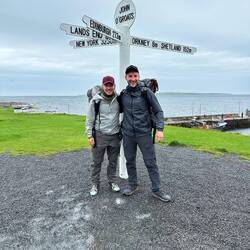
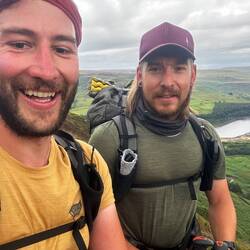
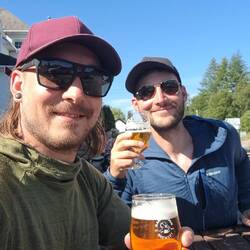
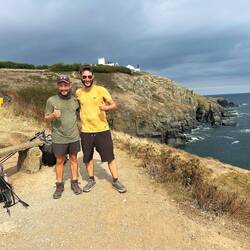
Where is your tent tonight?
Calculated on the recommended route; days end at a wild camping spot, bothy, youth hostel or village where possible.
Is this for you?
- Experience
You've done a few days with a tent and want something bigger. You don't need the AT or PCT under your belt.
- Time
Six to ten weeks in one go. At 32 km a day it's around eight weeks, not counting rest days.
- Tent
You like sleeping outside, in the rain too and without a shower. There are hostels and campsites on the way, but the tent is the plan.
- Solo or with a friend
We were two, but solo works just as well. You'll meet other walkers mostly on the well-known trails; in between you're often on your own.
Frequently asked questions
How hard is it?
Technically there’s nothing to it: no scrambling, no glaciers, mostly paths, sometimes bog and road. What makes it hard is the length. 1,766 km means walking every day for six to ten weeks with a full pack, in the rain too, and when your feet have had enough. The toughest part in the north for us was the John o’ Groats Trail (overgrown, hardly any waymarks southbound, wet feet for days); the Great Glen Way, on the other hand, is almost a stroll. Each trail page has a short profile of what to expect.
What experience do I need?
You should have done a few multi-day trips with a tent. Know how your pack feels after eight hours, how to pitch in the wind and what to cook when the next shop is two days away. You don’t need a thru-hike like the AT or PCT first; this is more the step before. The first two weeks are for getting used to it, then the trail legs kick in.
How long does it take?
Depends on your pace. At 25 km a day it’s a good 70 walking days, at 32 km around 56, at 40 km about 45. We took 49 walking days plus 3 rest days (30 June to 20 August 2025). In the day planner you set your pace and rest days and see roughly where you’ll end up each evening.
Can I wild camp?
In Scotland, yes: the Scottish Outdoor Access Code allows small tents for a few nights, well away from buildings and roads. There are exceptions, such as the permit zones at Loch Lomond. In England and Wales wild camping isn’t actually allowed. We did it anyway (late up, early off, out of sight) and never had trouble. If you’d rather not, there are campsites, hostels and youth hostels along the way. Our ground rules are under Sleeping out.
What do I do in an emergency?
Dial 999 or 112. In the hills or on the moors, ask for “Police”, then “Mountain Rescue”. Note down first: where you are (coordinates from your map app), who is hurt and how, how many of you there are, your mobile number. Then stay where you are until the rescue team contacts you (Mountain Rescue England and Wales). If you’re deaf, hard of hearing or speech-impaired, you can text 999, but you have to register your phone beforehand (Relay UK). For less urgent medical questions, call the NHS on 111.