JOGLPJohn o' Groats → Lizard PointPlan your walk

John o' Groats → Lizard Point · Summer 2025 · Patrick & Lorenz

Our gear

What lived on our backs for 49 days

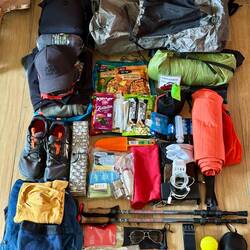
The night before the flight, everything was laid out on the living-room floor, and it looked like far too little. Seven weeks later we were standing at Lizard Point and nearly all of it was still there: a few pairs of shoes and socks down, a few dry bags up, one tear in a backpack, one power bank briefly missing. This is how our kit held up over 1,638 km from John o’ Groats to Lizard Point. With favourites, duds and the bits we still don’t agree on. If you only want weights and links, the packing list is the better place.

The 2025 gear awards

Every item did all 1,638 km. A few of them earned a prize.

  1. Hero of the trip

    T-shirt

    Decathlon Merino Fresh

    130 g~28 €worn✓ would take again

    Worn nearly every day for seven weeks, in sun, rain and wind. Started to smell later than we did and dried faster than we did. The only wish it left open was more colours; sadly there was only blue and yellow.

    AdSimilar on Amazon ↗

    More ↓
  2. Best flying trick

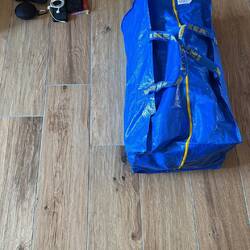
    IKEA bag (Frakta)

    Photo from day 1

    Backpacks on a plane are always a bit of a gamble, with all those straps and buckles. So each pack went into a blue IKEA bag. Worth every cent. In Scotland we then threw them away.

    IKEA ↗

  3. Best value per kilometre

    Trekking poles

    Crivit Aluminium (Lidl)

    532 g~18 €worn✓ would take again

    €18 at LIDL. Then swapped for some "better" ones someone had left behind. Those were soon done for. Lesson learned.

    AdSimilar on Amazon ↗

    More ↓
  4. Problem child

    Tent

    Lanshan 2 Pro

    920 g~200 €✗ not again

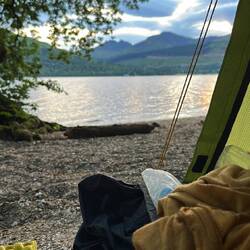
    Photo from day 14

    Really good for the price, and mostly it held up. But Loch Lomond and the Black Mountains were enough to raise our pulse at every wind forecast. Often more down to the ground, the spot and the pitching than the tent, though.

    More ↓
  5. Could have stayed at home

    Trousers

    Decathlon Zip-Off MT100

    479 g~35 €worn✗ not again

    Zip-offs. The legs came off and on really easily, but with shoes on it was still a faff. From week two we were in shorts whatever the weather anyway.

    More ↓
  6. Late bloomer

    Solar panel

    Anker PowerPort

    487 g~55 €✓ would take again

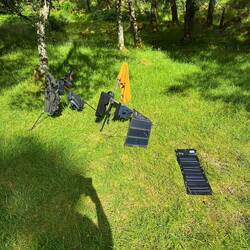
    Photo from day 10

    More ballast than benefit in Scotland. From England on it hung off the back of the pack every day and kept the power bank topped up.

    More ↓
  7. Lightest peace of mind

    Midge head net

    Highlander

    24 g~8 €✓ would take again

    24 grams. Hardly used in 2025. Came along anyway, because anyone who has met Scottish midges knows why.

    AdAmazon ↗

    More ↓
  8. Least used

    Head torch

    Nitecore NU25 UL

    60 g~20 €

    In high summer it never gets fully dark in Scotland. Only in the south did it come out a few times, far too rarely for the carrying. Once, though, it helped Patrick find the power bank in the grass. 3 m from the tent.

    AdAmazon ↗

  9. Rest in peace

    Shoes

    Altra Lone Peak 9+

    328 g~120 €worn✓ would take again

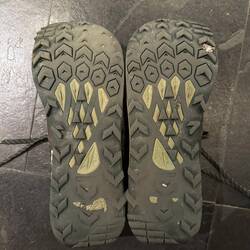
    Photo from day 29

    Patrick's first Altras. Not broken, just worn through after about 950 km. Buried deep in a bin in Hebden Bridge. The new pair? Exactly the same model.

    AdAmazon ↗

    More ↓

Patrick vs Lorenz

Same route, same backpack, two rather different packing lists.

Patrick

7.61kg

Base weight

Lorenz

6.92kg

Base weight

Lorenz is 693 g lighter, despite the diary and the tennis ball.in the pack, without food & water

Who carries more where?
  • Sleeping1.801.46
  • Clothing in the pack1.380.84
  • Electronics1.270.84
  • Backpack0.971.06
  • Tent1.180.85
  • Kitchen0.500.52
  • First aid0.000.55
  • Hygiene0.300.16
  • Other0.000.40
  • Tools & repair0.140.18
  • Documents0.080.07

kg

Only in Lorenz's pack

  • Reisetagebuch320 g

    A proper Moleskine, plus fountain pen and green ink. Written in every evening, whatever the weather. Patrick had FindPenguins.

  • Tennisball50 g

    'Fun and games', says his list. And a calf massage, say we.

  • Seil20 g

    Not really rope, more like 5 m of guy line. His note on the list: 'As Sam Gamgee said …'

  • Crafty0 g

    Lorenz himself, listed at 0 g with the description 'Geile Typ' (roughly: 'cool dude'). True: cool dude.

Lorenz's numbers come from his LighterPack list and may not be exactly what he had at the end of the walk.

Patrick's list with all weights →Lorenz's list on LighterPack ↗

Where we don't agree

Shoes: we don't agree on this one

Barefoot shoes or proper boots? Depends on your feet. Either way, break them in.

Patrick

I walk in barefoot shoes, or close to it: AdAltra Lone Peak, loads of room for the toes, zero drop. Light, quick to dry, and my toes don’t hurt. In Hebden Bridge I swapped the first pair after about 950 km for exactly the same model; it wasn’t broken, just worn through. I never once missed ankle support on the whole route; my boots have stayed in the cupboard ever since.

Lorenz

I started in trail runners too and switched back to boots on the way. I missed the support, my ankles and feet hurt, and in the roomy shoes my feet felt pretty lost. I need a proper hiking boot. My Meindls did give up eventually, though.

Whichever you pick: break them in. Don’t take shoes on the trip that you haven’t worn on a few long days with a full pack. Barefoot shoes take even longer; after years in narrow shoes, your feet and calves need time to adjust. And don’t rely on a write-up like this one. Try it yourself.

A pair lasts roughly 600 to 950 km. Tarmac eats the tread fastest and is the worst for your feet in the long run. Sand is hard work, but actually the kindest to your feet.

Socks: merino, but the right ones

Merino hiking socks, nothing else. Just don't assume the price tells you how long they'll last.

Patrick

I had AdDarn Tough and was very happy with them. The best socks I’ve had so far. They cost a small fortune, mind; I’d still buy them again straight away.

Lorenz

My Rohner socks were pretty expensive and still not great. By the border country between Scotland and England they were done for; after that I walked on in no-name socks from a Tesco.

We had no insoles and no gaiters. It was wet anyway; we couldn’t see the point.

What we learned

The long stories. Each with what we'd do differently today.

Your tent has to handle wind

It doesn't need to be a €1,000 tent. But it should be one you can pitch taut even on bad ground.

Patrick

I had the AdLanshan 2 Pro, which you pitch with your trekking poles. For the price it’s really good. The two or three nights it failed were more down to me, the ground, the spot and the weather: on hard or sloping ground I couldn’t get it taut enough, and in the wind it pushed in. On top of that I’m tall and had a thick sleeping mat, so my feet were almost against the tent wall. Ever since I nearly blew away at Loch Lomond, there was always a bit of panic at the back of my mind when the wind really picked up.

Lorenz

I had a Six Moon Designs Lunar Solo and was very happy with it. No real problems. I need less room than Patrick, so when it wasn’t perfectly pitched and pushed in a bit in the wind, it wasn’t a big deal for me.

Two or three nights were still just awful: the first one, which we crawled into soaking wet, one in a storm at Loch Lomond when Patrick suddenly found himself in half a tent, and one up on the ridge of the Black Mountains in Wales when it nearly took off.

Testing is tricky. Every tent stands fine in the garden. It gets interesting on sloping, stony ground where you can’t pitch a tent that relies on guy lines properly. If you can, spend a few nights somewhere windy before the trip. And if you’re tall, check the length, especially with a thick sleeping mat.

We bought the Lanshan footprint directly from the manufacturer (3F UL Gear) on AliExpress and sealed the seams ourselves with AdSeam Grip. By the way, Patrick has since got a freestanding tent with its own poles for next time, the Durston X-Dome Pro 1+, but hasn’t tested it yet.

Involved:

Backpack: light, but a wet back

We both had the Durston Kakwa 55. Ultralight, but the back isn't ventilated.

Patrick

I thought it was good. What bothered me: the back had no ventilation, so my back was always wet. When I took the pack off it got cold and gross fast, and eventually the pack started to stink too. Osprey makes packs with a well-ventilated back that are hardly heavier and maybe more comfortable. We tried one on in an outdoor shop and it seemed good; sadly I’ve forgotten the model. Next time I might get one of those.

Lorenz

Mine tore in one spot. For the price, that shouldn’t happen.

Ultralight also means thin fabric and no comfort extras. If you sweat a lot, try on a pack with a mesh back before the trip, for example from AdOsprey.

Wet feet, blisters and chafing

For the first week our feet were wet. All of the time.

No amount of drying helped; there just wasn’t enough sun. A dry pair of socks just for the night was sacred to us; in the morning it was straight back into the damp socks and damp shoes. With some foot cream and trimmed nails you can manage. We wouldn’t wish more than a week of it in a row on anyone, though, and keep an eye out for athlete’s foot.

Blisters came mostly at the start, and once more out of nowhere halfway through. Don’t tear them off. We pierced them, pulled a thread through so they could drain, and stuck Adblister plasters on. We’re not doctors; read up on it and try it before the trip. What helped most: a plaster between the little toe and the one next to it.

And it’s not just your feet that rub. Between your legs and your bum cheeks, AdVaseline or baby powder help, as do loose boxer shorts, or no underwear at all under loose trousers. Perfectly normal, just nobody talks about it. When both our shins started hurting (felt like shin splints, was really just overuse), a supportive bandage did the job.

Merino, shorts, and wrap up when you stop

At some point you're so used to the weather that you walk in shorts whatever it's doing.

We wouldn’t take zip-off trousers again. Great in theory. In practice we ended up walking in a Admerino shirt and shorts even in rain and cold, because they simply dry faster. As soon as you stop, you wrap up so you don’t get cold: Adfleece, and the rain jacket on top if needed.

Merino rather than synthetics, because it takes far longer to stink and washes out quickly. Maybe we’d take a few fewer clothes; then again, there were times we were glad of every layer. The only thing we missed: Adlight gloves for the really cold moments.

Small stuff that paid off

Small, light, and every time we were glad we had it.

  • AdHead net: hardly needed in 2025, but at 24 g it always comes along.
  • AdDry bags: we had too few at first and bought more on the way. Keeps electronics and bits and pieces dry and separate.
  • AdPermethrin: treat clothes, socks and shoes beforehand. The south-west is crawling with ticks. (Careful with cats; it’s toxic to them.)
  • AdPower bank and solar panel: 20,000 mAh; the panel hangs on the back of the pack during the day and charges the power bank. More in the FAQ.
  • AdTrekking poles from LIDL: great. On the way we swapped them for some “better” ones someone had left behind. Those wore out after a while. Regretted it. Expensive doesn’t mean better.

What wore out and what broke

Not much actually broke. Quite a bit wore out, though.

Patrick

Nothing of mine broke. My first pair of shoes was simply worn through after about 950 km, and I wrecked a few aluminium pegs on hard ground.

Lorenz

My pack tore in one spot, my Meindls gave up eventually, and the Rohner socks were finished by the border country.

And how it arrivedAnd how it arrived

Would we do it the same way again? Almost. Patrick would take a tent with its own poles and maybe a pack with a ventilated back, and we’d both start with more dry bags and no zip-off trousers. Everything else could come again. And if you’re packing right now: take our list as a starting point, tick off what you already have and leave out what you don’t need. Over 1,600 km, less is nearly always more.

Packing yourself?

On the packing list you can tick off our list, change it and turn it into a shopping list.

To the packing list →

Questions about our gear

How heavy were your packs?

Patrick’s pack weighed around 7.6 kg without food and water, Lorenz’s just under 7 kg according to his list. With a day or two of supplies it was more like 10 to 11 kg. The full list with all weights is on the packing list.

Trail runners or boots for walking across Britain?

Both, in our case. Patrick walked the whole way in Altra trail runners (two pairs, the first worn through after about 950 km), Lorenz switched to proper boots on the way. Expect 600 to 950 km per pair and break them in first.

Which tent for Scotland and Wales?

One that handles wind and that you can pitch taut even on hard, sloping ground. Patrick’s Lanshan 2 Pro was very good for the price, but borderline in storms on bad ground. Lorenz was very happy with his Six Moon Designs Lunar Solo.

As an Amazon Associate we earn from qualifying purchases. Links marked “Ad” are affiliate links: if you buy through them we receive a small commission at no extra cost to you. The texts may contain such links too.